
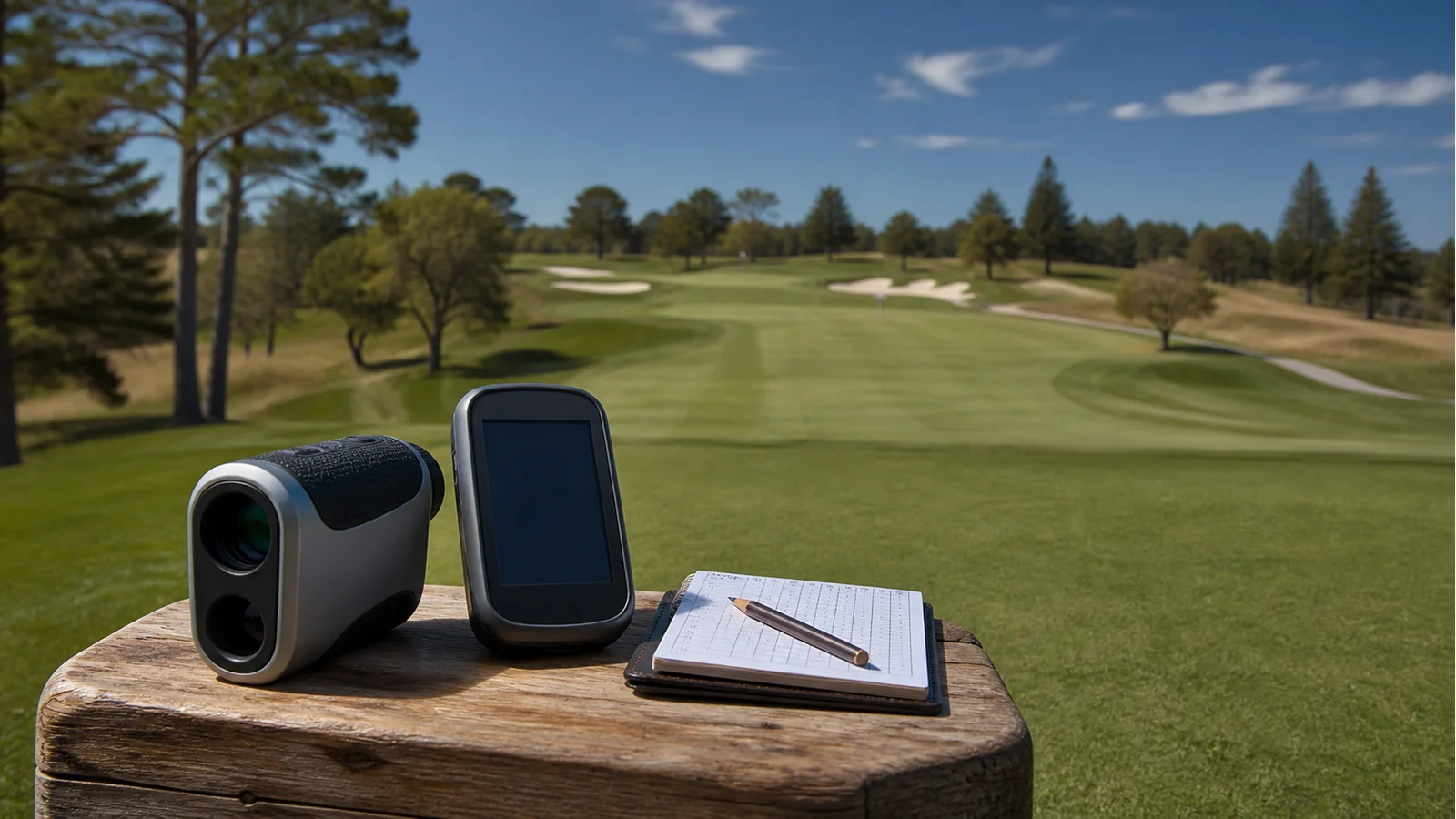
The best golf rangefinder is the one that gives a clear, repeatable distance quickly without adding friction to your routine. Choose a laser for exact target distance, GPS for automatic front/middle/back and hazard context, or a hybrid approach when you want both. Slope can help in practice, but it must be disabled when competition rules prohibit elevation-adjusted information.
Our shortlist favors practical usability: target acquisition, display clarity, measurement consistency, battery strategy, weather resistance, carrying method, and support. Product links may earn us a commission at no extra cost to you; prices and availability can change.
Quick picks by golfer
| Need | Best type | Why | Watch for |
|---|---|---|---|
| Exact flag distance | Laser | Point-and-measure precision to a visible target | Requires steady aim and line of sight |
| Fast course overview | GPS handheld or watch | Front, middle, back and hazard context | Course database, charging and subscription terms |
| Practice on hilly courses | Slope-capable laser | Shows measured and adjusted distance | Slope mode must be clearly disabled for regulated play |
| Maximum information | Hybrid laser/GPS | Combines target precision and hole mapping | Cost, complexity and battery demand |
Laser vs GPS rangefinders
A laser measures the distance to the object you aim at. It works well when the flag or hazard face is visible and you want a specific number. Modern target-lock or vibration feedback can confirm that the device has acquired a target, but trees and background objects can still complicate aiming.
GPS devices use mapped course data to show distances to reference points. They are valuable on blind shots and for planning around hazards, but the number describes a mapped point rather than the exact physical flag unless pin-location data is available. Check whether the device requires phone pairing, downloads, updates, or an ongoing subscription.
What matters most before buying
Target acquisition and display
Test whether you can lock onto a flag with one hand and read the display in bright sun and shade. Magnification helps only when the optics and focus control remain easy to use.
Repeatability
Take three readings from the same position. Small, stable variation is more useful than a device that occasionally produces a surprising number. Compare against a known marker, another reliable device, or course data.
Slope mode
Slope-adjusted distance estimates how elevation may change playing distance. It does not account perfectly for wind, temperature, lie, ball flight, or your strike. For events played under rules that disallow this function, use a model with an obvious physical or on-screen indication that slope is disabled and confirm the local competition rules.
Battery and charging
Replaceable batteries are convenient to carry as spares; rechargeable batteries reduce disposable cells but require charging discipline. Consider how many rounds a charge lasts and whether the cable is easy to replace.
Weather resistance and carrying
Check the manufacturer’s stated protection rather than assuming “water resistant” means submersible. A secure case, magnetic cart mount, belt clip, or trolley attachment should fit how you play without creating a drop hazard.
Who a rangefinder is for
Beginners may benefit most from simple front/middle/back GPS distances and learning realistic carry numbers. Improving golfers can use a laser to build a club-distance chart. Frequent travelers should prioritize course coverage and easy updates. Tournament golfers should select a device whose non-permitted functions can be disabled clearly and should always check event conditions.
How to test a rangefinder during the return window
- Confirm the display is readable with and without glasses.
- Measure the same target three times from 100, 150, and 200 yards where practical.
- Try a flag with trees or structures behind it.
- Check buttons while wearing a glove.
- Verify slope-off status is unmistakable.
- Test the case or mount during a full round.
- Review charging, battery, warranty, app, map-update, and subscription requirements.
Accuracy: what the number cannot tell you
A precise distance is not a complete club recommendation. Wind, temperature, elevation, lie, firmness, obstacles, and your actual carry dispersion still matter. Use the device to improve decisions, not to imply more shot control than you possess. Aim for the safest target that matches your normal pattern.
Common rangefinder mistakes
- Reading a background tree instead of the flag.
- Treating slope-adjusted distance as a perfect club choice.
- Buying more mapping features than you will use.
- Ignoring subscription or course-update requirements.
- Arriving with a depleted battery and no backup.
- Using a restricted function during a competition.
Frequently asked questions
Is a laser or GPS rangefinder better?
Neither is universally better. Laser is strongest for a visible, exact target; GPS is strongest for automatic hole context and blind-shot planning. Your routine determines the better fit.
Do beginners need slope?
No. It can be educational during practice on hilly terrain, but learning normal carry distances and safe targets usually matters more.
Can I use a rangefinder in a tournament?
Rules and event conditions vary. Distance-only functions may be allowed while slope or other advice functions are not. Confirm the competition’s current local rules before play.
How much should I spend?
Pay for reliable acquisition, a readable display, suitable battery life, and support. Premium mapping and hybrid features are valuable only if they fit your actual use.
Build the rest of your setup
Use measured distances with a realistic equipment plan. Continue with our beginner driver guide, high-handicap iron guide, and club-fitting checklist.
Make rangefinder data useful on the course
Build a simple carry-distance chart on the practice ground or during calm rounds. Record normal carry—not a career-best shot—for several clubs. On the course, combine the measured target with the distance to the front and back of the safe landing area. This often produces a better decision than firing directly at every flag.
For example, a laser may show 157 yards to the pin, but a GPS overview may reveal only 148 yards to clear a bunker and 174 yards to the back. If your normal shot pattern covers a wide range, selecting a club and target that keep most outcomes safe is more valuable than treating 157 as an exact instruction.
Phone app, watch, handheld, or laser?
A phone app can be the least expensive entry point, but screen visibility, notifications, battery drain, data access, and pace of play matter. A GPS watch keeps basic distances visible with little interruption. A handheld GPS can provide a larger map without putting a phone at the center of the routine. A laser adds exact visible-target measurement. Choose the format you will use consistently without delaying the group.
Privacy, updates, and total ownership cost
Connected devices may request an account, location access, phone permissions, or cloud synchronization. Review what is required and whether core distance functions continue without a subscription. Also check map-update policy, replacement charging cables, battery service, warranty length, and support availability. These ownership details can separate two products that look similar on a feature list.
Care and storage
Keep lenses clean with an appropriate soft cloth, protect the device from loose tees and grit, and let a wet case dry before closing it. Avoid prolonged heat in a vehicle. Charge rechargeable models before travel and carry an approved spare cell for replaceable-battery devices. Before an important round, confirm the course map is downloaded and the measurement units are correct.

Leave a Reply