
Editorial disclosure: This is a research-based assessment built from COBRA’s official 2026 specifications. We have not independently tested the clubs with junior golfers. Fit guidance is educational; growth, strength and coaching context should be considered before purchase.
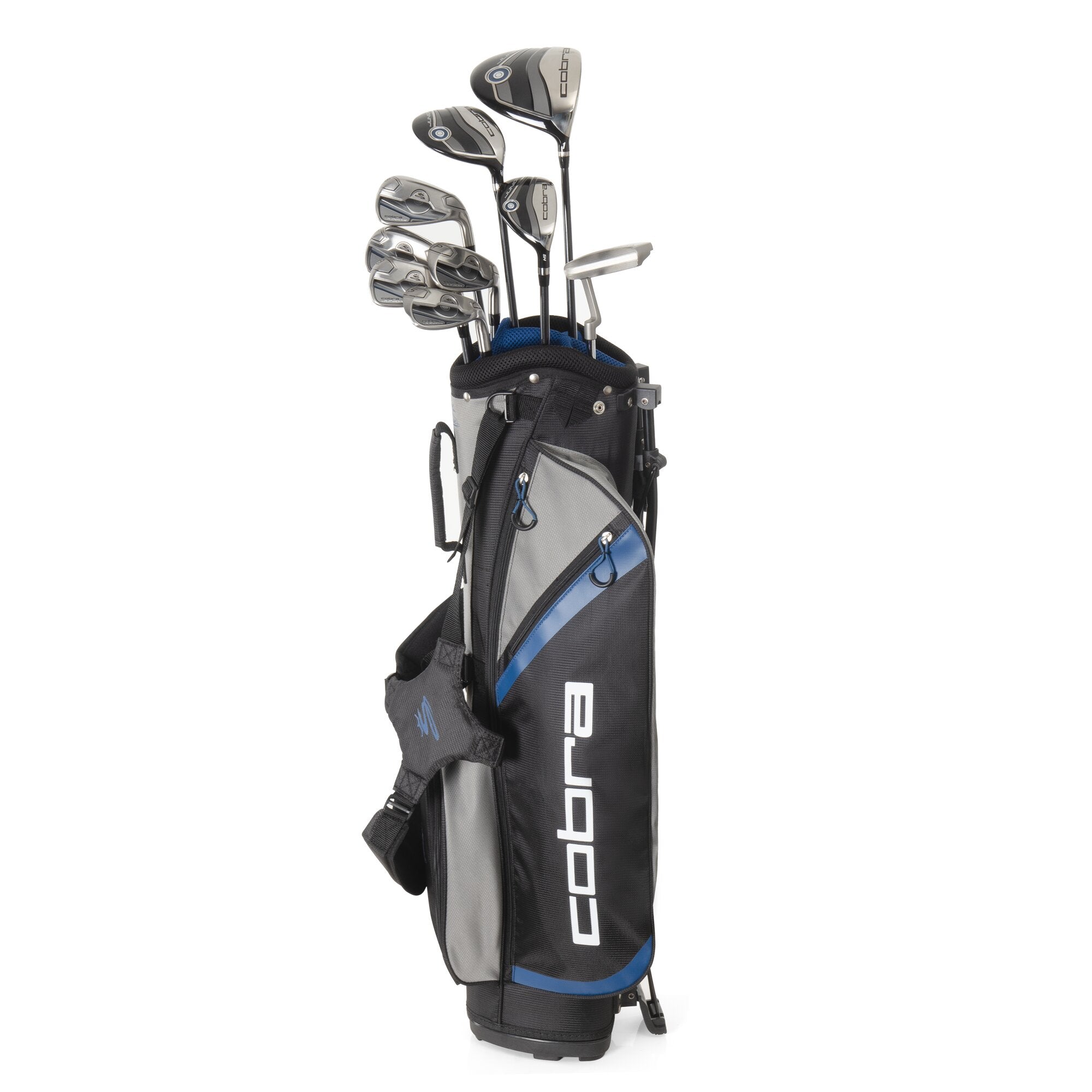
The 2026 COBRA Junior KING Complete Set is a serious youth package organized around three age-and-height bands rather than one generic junior length. It includes forgiving woods, hybrids or irons according to the player’s stage, a sand wedge, blade putter and bag. Its strongest feature is progressive composition. Its biggest buying risk is choosing by birthday while ignoring actual height, posture, strength and growth.
QUICK VERDICT
Our research-based take
Best for: an ambitious beginner or developing junior who needs a correctly scaled, coordinated set and is likely to play or practice consistently.
Skip it if: the child falls well outside the published height band, needs only a few starter clubs, or is growing into adult specifications within a short period.
Rating: 8.7/10 for progressive fit logic and left-hand inclusion.
Check current COBRA specifications →
Three sets, not one scaled-down adult bag
COBRA publishes separate configurations for ages 7–9 at 42–50 inches tall, ages 10–12 at 51–59 inches, and ages 13–15 at 60–65 inches. The club count grows with the player. The youngest configuration uses a driver, hybrid, selected irons, sand wedge and putter. The middle group adds a fairway wood and expands coverage. The oldest group receives the fullest progression, including driver, fairway, hybrid, 7-, 8- and 9-irons, pitching wedge, sand wedge and putter.
This progressive structure is sensible. A small beginner does not need fourteen clubs or tightly spaced lofts. Extra clubs increase bag weight and decision complexity. As swing speed and shot consistency develop, narrower gaps and more specialized clubs become useful. COBRA’s composition broadly follows that progression.
Published fit bands and key specifications
| Version | Published height | Key long clubs | Scoring clubs |
|---|---|---|---|
| Ages 7–9 | 42–50 in | 16° driver, 27° hybrid | Selected irons, 55° SW, putter |
| Ages 10–12 | 51–59 in | 16° driver, 23° fairway, 27° hybrid | Selected irons, 55° SW, putter |
| Ages 13–15 | 60–65 in | 13° driver, 18.5° fairway, 23.5° hybrid | 7–9, PW, 55° SW, putter |
COBRA states that all three sets are available in right- and left-handed versions. That is important because junior left-handed options are often limited. The official specifications include individual loft, lie and shaft length values, enabling a parent, coach or fitter to compare the set with the player’s current equipment rather than relying on an age label alone.
Why height should lead the decision
Age bands are a convenient product name, not a complete fitting method. Two children of the same age can differ greatly in height, arm length, strength and coordination. Start with the published height range, then observe setup. The grip should not force the player excessively upright or bent over, and the club should be light enough to finish in balance. Choking down can provide temporary flexibility near the bottom of a range, but it should not be used to justify a club that is dramatically too long or heavy.
Do not automatically buy the next size “to grow into.” Oversized junior clubs can encourage heel strikes, late face control and compensating posture. The savings from extending a purchase may be offset by poorer learning. A correctly scaled partial set is usually better than a full set the child cannot swing freely.
Long-club design by age group
The youngest and middle versions use a 16-degree driver. That is substantially more loft than a typical adult driver and supports launch at lower clubhead speeds. The oldest version moves to 13 degrees as strength and speed are expected to increase. The fairway wood is omitted in the youngest published configuration, a reasonable simplification because low-loft turf shots can be difficult and redundant for a new player.
The hybrid acts as the bridge into the irons. A 27-degree hybrid in the first two groups provides a broad sole and confidence-inspiring alternative to a long iron. The 13–15 version moves to 23.5 degrees and then a 30.5-degree 7-iron. Actual gaps will depend on swing speed and contact, but the sequence is logically spaced.
Irons, wedge and putter
The iron count increases with age and expected skill. That keeps the youngest bag light while giving the oldest player more approach options. Every version includes a 55-degree sand wedge, which introduces bunker and greenside technique without requiring multiple specialty wedges. Coaches may initially teach one simple lofted-club motion before expanding the short-game matrix.
The package uses a blade putter with 3 degrees of loft. A blade is easy to position and keeps the bag compact, though it may offer less visual alignment help and perimeter stability than a large mallet. Putter style matters less than correct length and a setup the junior can repeat. Published putter lengths rise from 27.1875 inches to 31.1875 and 33.1875 inches across the three groups.
Pros and cons
Pros
- Three progressive height/age configurations.
- Club count grows with player development.
- High-loft drivers support junior launch conditions.
- Hybrid-led transition avoids demanding long irons.
- Published loft, lie and length specifications.
- Right- and left-handed availability.
- Complete coordinated bag reduces compatibility guesswork.
Cons
- Age labels can encourage incorrect sizing.
- Growing players may move through a fit band quickly.
- Blade putter offers less stability than some mallets.
- Complete package may be excessive for a child only trying golf.
- No independent durability or launch-monitor data is available in this review.
Who should buy it?
The ideal buyer is a junior who has shown sustained interest, has access to practice or regular rounds and falls comfortably within a published height range. The set is especially attractive for parents who want a recognized equipment brand, a structured gapping plan and a left-handed option. It can support lessons because the coach is not compensating for a random collection of adult cut-down clubs.
A first-time child attending one clinic may need only a driver or hybrid, mid-iron, wedge and putter. Borrowing or renting can be better until interest is established. A strong 13–15-year-old near 65 inches may be close to adult or women’s specifications and should compare total weight, shaft profile and grip size through a fitting rather than automatically choosing the oldest junior package.
Why cut-down adult clubs are not equivalent
Shortening an adult shaft changes more than length. The club can remain too heavy, the head can dominate the swing, the grip may be oversized and the effective balance can feel awkward. Junior equipment is intended to scale the whole system. A cut-down club can work when built thoughtfully, but simply sawing an old adult set is not a reliable fitting strategy.
Parent and coach buying checklist
- Measure current height without shoes and compare it with the official band.
- Check wrist-to-floor distance and athletic posture.
- Let the junior make balanced swings; do not judge only static address.
- Confirm right- or left-handed preference through actual swings.
- Consider growth, but do not purchase a dramatically oversized set.
- Check bag weight and whether the player will carry, push or ride.
- Reassess length and grip condition during growth spurts.
- Confirm current regional price, stock, warranty and included club count.
Frequently asked questions
Should I choose by age or height?
Use height as the stronger first filter, then verify posture, strength and swing balance. Age alone is not a fitting measurement.
Are left-handed sets available?
COBRA’s official product information states that all sets are available in right- and left-handed versions, though regional stock can vary.
Can a 12-year-old use the 13–15 set?
Possibly if the player’s height and physical development match that version, but the label should not override fit. Test length and total weight.
How long should a junior set last?
That depends on growth rate, wear and skill development. Recheck fit during rapid growth rather than waiting for a birthday. Grips may need replacement before the player outgrows the heads.
Does a junior need every club?
No. Beginners benefit from fewer clear choices. The progressive COBRA compositions recognize that, but a child with uncertain interest may still start with a smaller subset.
Final verdict
The 2026 COBRA Junior KING Complete Set stands out for treating junior golf as a progression rather than a single miniature adult bag. High-loft woods, hybrids, scaled lengths and increasing club counts are appropriate design choices. The value depends on selecting the correct size at the correct time. Measure first, resist buying too large, and involve a coach or fitter when the junior sits between categories. Correctly matched, this is a credible foundation for learning; incorrectly sized, the brand name cannot compensate.

Leave a Reply