
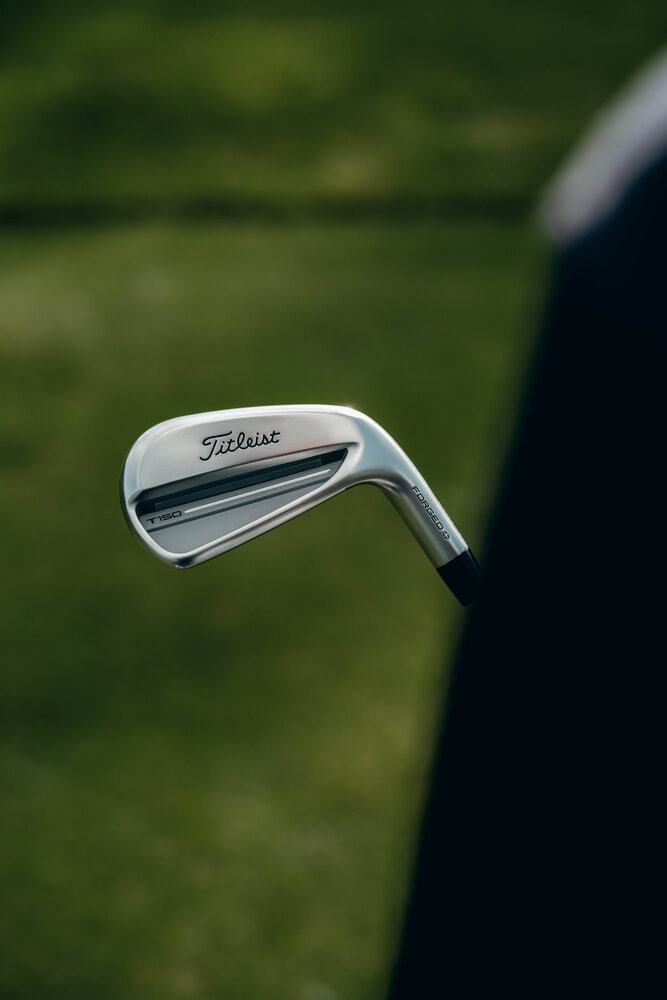
Golf-club lie angle is the angle formed by the shaft and the sole when the club is placed in its intended address position. An upright setting raises the toe relative to standard; a flat setting lowers it. The correct fit helps the sole and face arrive predictably at impact, but lie angle is not chosen from height alone. Posture, arm length, club length, delivery, strike location and face control all matter.
Upright vs flat lie angle at a glance
| Setting | What changes | Possible impact clue | Common trade-off |
|---|---|---|---|
| More upright | Toe sits higher relative to standard | Toe-down delivery or marks toward the toe side of the sole | Too upright may bias the face left for a right-hander |
| Standard | Manufacturer’s published baseline | Neutral sole/face interaction for that model and length | “Standard” differs among brands and models |
| Flatter | Toe sits lower relative to standard | Heel-down delivery or marks toward the heel side of the sole | Too flat may bias the face right for a right-hander |
Why lie angle influences direction
An iron face has loft, so tilting the club changes where that loft points. When the toe is excessively high at impact, the loft plane can point left of the target for a right-handed player. When the toe is excessively low, it can point right. The effect becomes more visible as loft increases, which is why a poorly fitted short iron or wedge may show a stronger directional pattern than a low-lofted long iron.
This is only one contributor to start direction. A golfer can pull shots with a correctly fitted club by closing the face or swinging left. A player can also compensate for a poor lie by changing posture or hand height. Fitting should identify the equipment setting that supports the player’s repeatable motion—not force a mechanically perfect-looking sole position on one swing.
Static lie angle is the starting point
Static fitting commonly considers player height and wrist-to-floor measurement. Those numbers estimate how club length and lie might interact at address. They are useful for narrowing the test range, especially when ordering a set, but they cannot show how the shaft bends or how the golfer delivers the handle at impact.
Two golfers of the same height may need different lie angles because their arm length, posture, hand height and motion differ. A taller golfer does not automatically require upright clubs; longer clubs can themselves make the effective playing lie more upright. See our club-fitting measurements checklist for the measurements that belong in the initial assessment.
Dynamic lie angle is what happens at impact
Dynamic lie describes the club’s delivered orientation during the strike. Shaft droop, release pattern, hand height and turf interaction can move it away from the address appearance. A club that looks toe-up on a shop floor can arrive differently when swung at speed.
A fitter may combine launch-monitor data with face tape, a marked ball, sole evidence and high-speed video. No single observation should make the decision. The goal is a repeated pattern across several representative swings, including normal misses—not one perfect strike produced after the golfer begins steering the club.
Three practical lie-angle tests
Marker-line ball test
Draw a straight vertical line on the ball with a suitable marker, place the line facing the club, and strike from a mat into a screen. The transferred line on the face shows how the club was oriented at impact. A tilted line can indicate a lie adjustment, but the test must be repeated because off-center strikes and imperfect line placement add noise.
Impact location and launch data
Face spray or tape shows strike location, while a launch monitor records start direction, spin axis and dispersion. Lie is more convincing as a cause when the directional pattern changes predictably across controlled lie settings without the golfer altering the swing.
Turf and sole interaction
Real turf reveals whether the heel or toe catches first, but traditional lie boards can exaggerate conclusions because sole shape, board friction and strike location affect the mark. Use a lie board as supporting evidence rather than the final answer.
Common symptoms—and why they are not proof
| Symptom | Possible lie explanation | Other causes to check |
|---|---|---|
| Repeated starts left (right-hander) | Club may be too upright | Closed face, leftward path, grip or alignment |
| Repeated starts right | Club may be too flat | Open face, rightward path, strike and alignment |
| Toe digs deeply | Delivered lie may be too flat | Steep attack, uneven ground or late balance change |
| Heel catches first | Delivered lie may be too upright | Handle drop, early extension or strike location |
| Short irons pull more than long irons | Upright fit can be amplified by loft | Set makeup, offset, swing length or face control |
Club length and lie angle must be fit together
Adding length moves the player’s hands and can make a club play more upright; shortening can make it play flatter. A fitter should establish a usable length before finalizing lie. Changing lie to compensate for the wrong length may create poor posture, inconsistent strike or awkward gapping.
Grip size and total club weight also influence how the golfer delivers the handle. This is why an isolated online chart cannot replace testing. The correct specification is a system: length, lie, head design, shaft and grip must allow centered contact and manageable dispersion.
Should every iron use the same lie adjustment?
Many sets are ordered with a uniform adjustment—such as one degree upright—but that is not the only approach. Some players benefit from progressive or individually checked lie angles because delivery and posture change through the set. Manufacturing tolerances and normal use can also cause actual specifications to differ from catalog numbers.
At minimum, test a long or mid iron and a short iron. If the pattern changes meaningfully, have several clubs measured rather than assuming the entire set is correct. Wedges deserve separate attention because they are used with different face angles and shot lengths.
Cast vs forged irons and bending limits
Whether a club can be adjusted—and by how much—depends on head material, hosel design, construction, age and manufacturer guidance. Forged heads are often easier for a qualified technician to bend, but that does not make every forged model unlimited. Some cast heads can be adjusted safely within a small range; others carry a greater risk of cracking, cosmetic damage or altered warranty coverage.
Never bend a club with improvised tools. Ask a professional to measure the current specification, inspect the head and confirm an appropriate adjustment range. Recheck loft after bending because loft and lie can influence each other during the process.
Who should consider a lie-angle fitting?
- Golfers with a persistent start-direction pattern across multiple irons.
- Players moving to longer or shorter clubs.
- Golfers whose posture, mobility or hand height has changed.
- Anyone buying a new iron set or a used set with unknown specifications.
- Players seeing heel- or toe-dominant turf interaction despite centered face contact.
A full fitting is especially valuable before a major purchase. Our club-fitting cost and checklist guide explains common fitting formats and what information to bring.
A step-by-step buying and fitting checklist
- Measure current club length, loft and lie rather than trusting labels.
- Record strike location and start direction with normal swings.
- Take height and wrist-to-floor measurements as a starting reference.
- Test at least three lie settings while keeping head, shaft and length consistent.
- Compare dispersion and contact, not just the best shot.
- Verify a mid iron and a short iron; test wedges separately if needed.
- Have the finished clubs measured after delivery or adjustment.
- Retest after a meaningful swing or posture change.
Lie angle when buying used irons
Used clubs may have been bent for a previous owner even when the listing says standard. Ask for measured specifications or budget for a local check. Color codes and factory markings can describe an original build, but they do not prove the current angle after years of adjustments and play.
Inspect the hosel for bending marks, cracks or finish damage and confirm the model’s adjustment guidance. Read our used-club inspection checklist before committing to a set.
Frequently asked questions
How many degrees upright or flat do I need?
There is no reliable answer from height alone. Test nearby settings dynamically and choose the smallest change that improves repeated contact and start direction.
Can lie angle fix a slice?
It may influence start direction, but it does not repair an open face or out-to-in path. Treat persistent curvature as a swing and face-delivery question first.
Does lie angle affect distance?
Indirectly. A poor fit can reduce centered contact or send shots offline. Loft, speed and strike remain the primary distance variables.
How often should lie angles be checked?
Check after impact damage, an adjustment, a significant swing change, or when a new directional pattern appears. Golfers who practice heavily on firm mats may choose periodic checks.
Can wedges use a flatter lie than irons?
Yes. Some players prefer flatter wedges because short-game posture and handle position differ, but the choice should be verified with the shots and face angles they actually use.
Bottom line
Upright and flat are fitting directions, not player categories. Establish a practical club length, use static measurements to create a starting range, then verify dynamic lie with repeated strikes and ball-flight data. Choose the smallest setting change that improves contact and dispersion without forcing the golfer to compensate.
Affiliate disclosure: Golf Buying Guide may earn a commission from qualifying purchases made through links on this site, at no additional cost to you. Recommendations are based on fit, intended use and trade-offs rather than commission.

Leave a Reply