
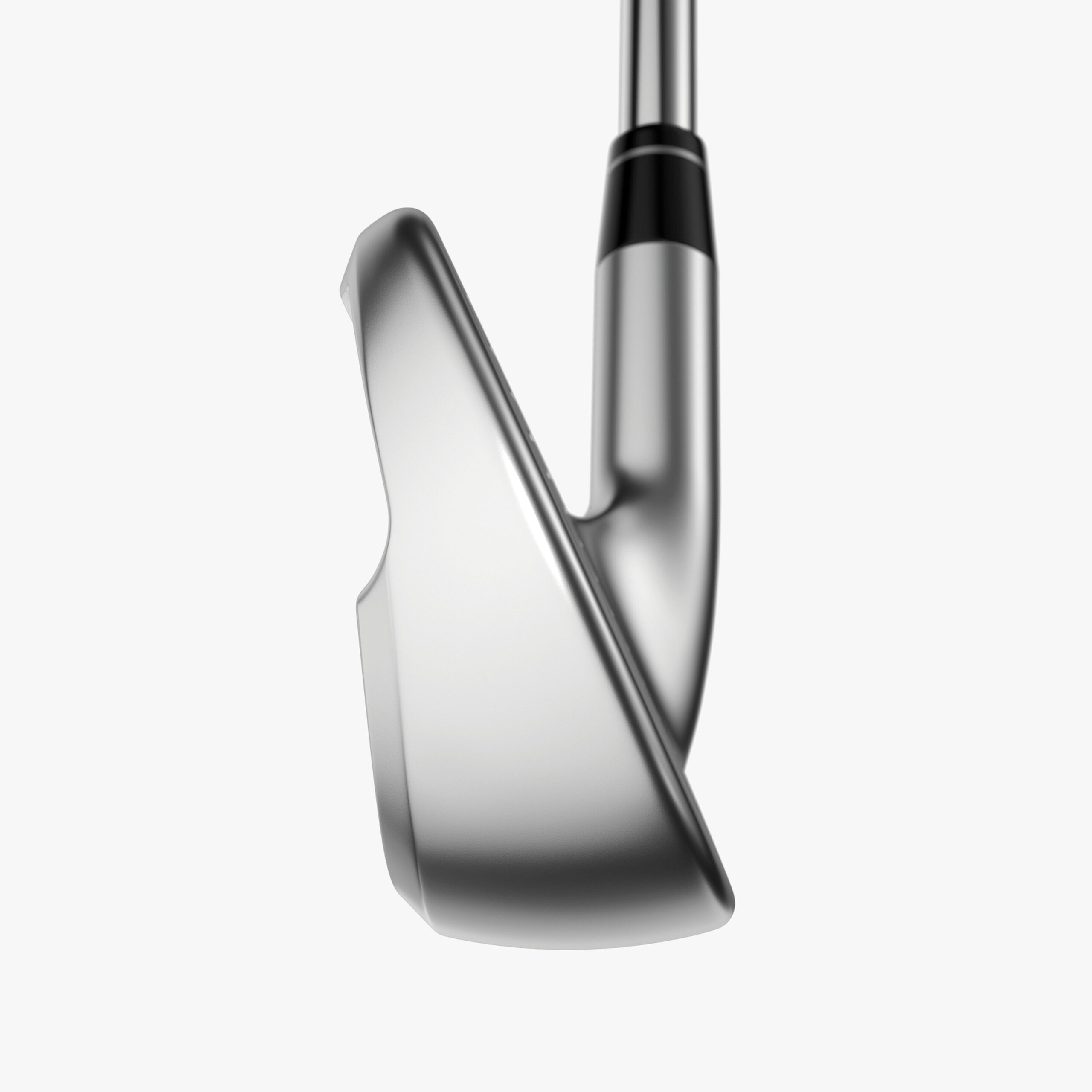
Callaway irons by year span several distinct families rather than one continuous replacement line. Big Bertha and later game-improvement models emphasize launch and forgiveness; the X-series became a long-running mainstream line; Apex and X Forged address compact, forged, and players-distance preferences; and recent Paradym, Elyte, Ai Smoke, and Quantum families expand the fitting range.
This timeline is designed for identification and used-buying research. A model year does not prove that a set is authentic, correctly configured, or suitable for your swing. Always confirm the exact head name, set composition, shaft, length, lie, loft, and condition before buying.
Callaway irons by year: quick timeline
| Year | Notable Callaway iron families and models | What the period represents |
|---|---|---|
| 1988–1994 | S2H2; Bobby Jones; early Big Bertha | Early Callaway iron identity and oversize, perimeter-weighted development |
| 1996–2000 | Big Bertha; Gold Series; Great Big Bertha Tungsten Titanium; X-12; Hawk Eye; X-14 | Expansion of forgiving cavity designs, multi-material weighting, and the X-series |
| 2002–2009 | Big Bertha 02/04/06; X-16; X-18; Fusion Wide Sole; X-20; X-22 | Broader game-improvement and reduced-offset/Pro alternatives |
| 2010–2013 | X-24 Hot; Diablo Forged; RAZR X families; X Hot; X Forged | Distance-oriented faces alongside forged and Tour-style options |
| 2014–2017 | Apex; Apex Pro/MB; X2 Hot; XR; Apex CF16; Steelhead XR; Big Bertha OS; Epic | Apex becomes a central premium family while XR and Big Bertha cover forgiveness |
| 2018–2020 | Rogue/Rogue X/Rogue Pro; X Forged; Apex 19; Big Bertha 19; Epic Forged; Mavrik | Multiple head sizes and launch profiles organized around player need |
| 2021–2023 | Apex 21, Pro, DCB, TCB and MB; Big Bertha B21; Rogue ST; Paradym; Paradym X; Big Bertha 23 | Clearer separation between compact, players-distance, and maximum-help designs |
| 2024–2026 | Paradym Ai Smoke; Apex Ai200/Ai300; Apex Pro/CB/MB/TCB; Ti Fusion; Elyte; X Forged 25; Apex Ai150; Quantum Max/OS/Fast; XR | Current fitting families with extensive construction, size, speed, and set-makeup choices |
Model availability varies by country, hand, shaft, set composition, and date. Callaway’s official trade-in documentation is useful for confirming model names and model years, but it is not a fitting recommendation.
Early Callaway irons: S2H2 to Big Bertha
Callaway’s early iron story is tied to the company’s S2H2 design language and the growth of the Big Bertha name. The historical product material identifies S2H2 irons from the late 1980s into the early 1990s, followed by Bobby Jones and early Big Bertha models. These clubs belong to a different specification era from modern sets: long irons were common, lofts were generally less aggressive than many current distance irons, and original shafts and grips may now be decades old.
For a collector, originality may matter. For a golfer, playable condition matters more. Check for shaft corrosion, loose ferrules, worn faces, mismatched serial or cosmetic details, altered lengths, and replacement shafts installed to inconsistent depths. Very old bore-through constructions may also require a repair specialist familiar with the design.
The X-series era: X-12, X-14, X-16, X-18, X-20 and X-22
The X-series is one of the clearest ways to organize Callaway’s iron history. Company filings place the X-12 introduction in 1998 and describe the X-14 as its replacement in 2000. Callaway’s historical service information then lists X-16, X-18, X-20, and later X-22 generations. Pro Series or Tour-oriented variants often used less offset or a more compact presentation than the standard model, so two sets sharing the same number may not frame the ball in the same way.
Used buyers should not assume a higher X-number is automatically better. Compare the actual 7-iron loft, sole width, offset, shaft, and set makeup. A clean matched X-18 or X-20 set with a suitable shaft can be more useful than a newer but poorly fitted or heavily worn alternative.
2010–2013: X-24 Hot, Diablo Forged, RAZR and X Hot
Callaway’s 2010–2013 period included both distance-oriented and forged options. X-24 Hot continued the numbered X lineage, Diablo Forged offered a different construction and profile, and the RAZR family included standard, Tour, Forged, Muscleback, Black, XF, and HL identities across 2011–2012. In 2013, X Hot and X Hot Pro sat alongside X Forged and other targeted models.
This is a period where exact naming is essential. “RAZR X” is not enough to identify RAZR X Tour, RAZR X Forged, RAZR XF, or RAZR X HL. Photograph the cavity badge and sole, then match the complete name before researching specifications or replacement clubs.
2014–2017: Apex becomes a major Callaway iron family
Apex arrived as an important premium name in 2014, with Apex, Apex Pro, and Apex MB variations appearing around this phase. X2 Hot addressed a different buyer, followed by XR and XR Pro in 2015. The 2016 catalog became particularly broad: Apex CF16, Apex Pro 16, XR OS, Steelhead XR, Big Bertha OS, and related models covered very different head shapes and player needs. Epic and Epic Pro followed in 2017, alongside Steelhead XR Pro and Epic Star.
The practical lesson is that “Apex” does not always mean a traditional blade. Across generations, Apex has included players-distance, Pro, cavity-back, muscle-back, deep-cavity, utility, and combo-set concepts. Identify the suffix and year before comparing it with another Apex set.
2018–2020: Rogue, Apex 19, Epic Forged and Mavrik
The 2018 Rogue group included Rogue, Rogue X, Rogue Pro, and later cosmetic or regional variants, while X Forged and Apex MB served golfers seeking a different profile. In 2019, Apex 19 and Apex Pro 19 were joined by Big Bertha 19 and Epic Forged models. Mavrik, Mavrik Max, and Mavrik Pro formed the principal 2020 family.
When cross-shopping these generations, compare launch and stopping power rather than raw loft. A strong-lofted iron that launches adequately can work well, but the same loft with insufficient peak height or spin may create poor distance control. Gapping into hybrids and wedges is just as important as the iron number printed on the sole.
2021–2023: Apex 21, Rogue ST and Paradym
The 2021 Apex range made the family structure easier to see: Apex 21, Apex Pro, Apex DCB, Apex TCB, Apex MB, mixed sets, and utility options served different preferences. Big Bertha B21 and REVA products addressed other fitting requirements. Rogue ST Max, Max OS, Max OS Lite, and Pro variants followed in 2022.
Paradym and Paradym X arrived for 2023 alongside updated Big Bertha and related offerings. Callaway’s official Paradym comparison distinguished a more compact players-distance direction from a more forgiving, wider-sole Paradym X direction. That distinction is more useful than treating every 2023 Callaway iron as one technology package.
2024–2026: Ai Smoke, Apex Ai, Elyte and Quantum
Callaway’s official 2024-era listings include Paradym Ai Smoke standard, HL, Max Fast, and women’s variants, plus Apex Ai200 and Ai300. Apex Pro, CB, MB, TCB, Ti Fusion, utility, and combo configurations further expand the range. The official Apex Ai200 specifications, for example, identify it as a forged hollow-body/forged-face design and list a 30-degree 7-iron; this is a useful reminder to compare actual loft and construction rather than relying on a category label.
The 2025 listings add Elyte, Elyte X, Elyte HL, Elyte Max Fast, X Forged 25, Apex Ai150, and REVA Rise identities. Callaway’s August 2026 trade-in rate card lists Quantum Max, Quantum Max OS, Quantum Max Fast, and 2026 XR iron sets. These are current references at the time of this update, not a promise that every configuration is available in every market.
How to choose between Callaway iron families
| Need | Family direction to investigate | What to verify in a fitting |
|---|---|---|
| Maximum launch and forgiveness | Big Bertha, OS, HL, Max Fast, DCB, or larger game-improvement variants | Peak height, carry consistency, sole interaction, offset comfort |
| Players-distance balance | Apex standard/Ai200, Paradym standard, selected forged hollow-body models | Front-to-back dispersion, spin, gapping and sound/feel preference |
| Compact control-focused profile | Apex Pro, CB, TCB, MB, X Forged and Pro variants | Strike consistency, launch, long-iron usability and combo-set need |
| Used-value set | Clean matched prior-generation set from any suitable family | Identity, shaft, length, lie, loft, condition, authenticity and return rights |
Used Callaway iron inspection checklist
- Identify the complete model. Record every suffix—Pro, Tour, OS, HL, Max Fast, DCB, TCB, X, or Star can change the design materially.
- Confirm set consistency. Check that heads, shafts, ferrules, grips, and serial markings form a logical matched set.
- Inspect faces and soles. Heavy wear, browning, gouges, and rock damage affect value and may affect performance.
- Check shafts. Look for rust, dents, splits, label inconsistencies, and extensions. Roll the shaft gently to look for obvious bends.
- Measure before assuming. Used clubs may have been bent, lengthened, shortened, reshafted, or strengthened.
- Check the wedge end. Stronger loft structures may require an additional gap wedge or a different wedge setup.
- Use protected payment and returns. Counterfeit risk and undisclosed alterations are harder to resolve in an unprotected private transaction.
Frequently asked questions
What year did Callaway X-12 irons come out?
Callaway company filings state that Big Bertha X-12 irons were introduced in January 1998.
What year did Callaway X-14 irons come out?
Callaway announced Big Bertha Steelhead X-14 irons in January 2000; the Pro Series followed later in 2000 according to company filings.
Are old Callaway irons still playable?
They can be, if the specifications suit the golfer and the heads, shafts, and grips remain safe and consistent. Age alone is less important than fit and condition.
Which Callaway irons are most forgiving?
Look first at larger game-improvement, OS, HL, DCB, Max Fast, Big Bertha, and hybrid/iron combo directions, then verify launch and dispersion in a fitting. The most forgiving model is not identical for every delivery.
Is Apex always a players iron?
No. Apex has covered multiple constructions and player profiles, including standard players-distance, Pro, CB, MB, TCB, DCB, utility, and combo configurations.
How often should this timeline be updated?
Review it whenever Callaway releases or catalogs a new iron family and verify the current official listing before making a purchase.
Sources
- Callaway Golf — current iron sets
- Callaway Golf Values rate card, updated August 1, 2026
- Callaway corporate filing — X-12, X-14 and historical product descriptions
- Callaway Apex Ai200 official specifications
Continue with our high-handicap iron guide, club-fitting checklist, and used-club buying guide.

Leave a Reply