

Introduction
Let’s be real—finding the right golf irons is like dating. You try a few out, find one that feels right, and hope it sticks for the long haul. For decades, Cleveland Golf has been in the business of crafting irons that appeal mostly to everyday players who want one thing: performance without the intimidation. But Cleveland hasn’t always been about irons—they earned their stripes in the wedge game first. So, how did Cleveland go from a wedge kingpin to producing some of the most forgiving irons in the golf world? That’s exactly what this guide is about.
We’re going deep into the evolution of Cleveland irons by year. Whether you’re a nostalgic gear junkie, a mid-handicapper searching for your next set, or just curious how far Cleveland irons have come, you’re in for a ride. From the weird-looking but iconic VAS irons in the ’90s to the hybrid-like Launcher HB sets that have won the hearts of many weekend warriors, this is your complete guide to Cleveland irons—year by year, feature by feature.
The Rise of Cleveland Golf
Founded in 1979 by Roger Cleveland, Cleveland Golf didn’t jump into the iron game right away. They made a name for themselves with high-performance wedges. The company built its rep by mimicking classic club shapes from the 1940s and 50s but giving them modern tech upgrades. For a while, their focus was crystal clear—own the short game. But as their credibility grew, Cleveland set their sights on something bigger.
By the 1990s, Cleveland realized that to be a true player in the golf equipment game, they needed a full set of clubs. So, they shifted gears and decided to bring their design philosophy—simple, functional, effective—into the iron market. But the road was anything but smooth.
The irons game was already dominated by giants like Titleist, Ping, and Callaway. Cleveland had to be different. So what did they do? They got bold. Some say they got weird (VAS irons, anyone?). But one thing’s for sure—they made an impact. Their irons were designed for the average golfer, not the tour pro. That philosophy stuck, and it shaped everything that came after.
1990s: The Beginning of Cleveland Irons
Let’s throw it back to 1995. The world met the Cleveland VAS 792 irons—and wow, were they controversial. The VAS (Vibration Absorbing System) irons were a bold swing at innovation. With oversized heads, offset hosels, and an unconventional shape, these irons looked like nothing else on the market.
So why the weird design? Simple. Cleveland wanted to eliminate vibration on off-center hits, offering more forgiveness and comfort. It was aimed at mid-to-high handicappers who didn’t care how a club looked as long as it worked.
However, traditionalists were not fans. Critics slammed the aesthetics, and even some players felt self-conscious pulling them out of the bag. But performance-wise? Solid. They were forgiving, easy to hit, and packed with distance for the time. The VAS series laid the foundation for what Cleveland irons would become—unapologetically functional and built for the everyday golfer.
Other lesser-known models also trickled out during this decade, but none got attention like the VAS. Still, Cleveland learned a lot in this era—especially about what golfers loved (and hated). That feedback helped shape the next decade of designs.
2000–2005: Building Momentum
As the 2000s rolled in, Cleveland got more focused—and a little more refined. Enter the Launcher series in 2001. These irons matched the same branding as their popular Launcher drivers, giving the sets a cohesive identity.
But what really stood out during this period were the Cleveland TA irons—especially the TA5 and TA7 models. These were transitional sets that bridged the gap between beginner and intermediate players. They had sleeker looks than the VAS and better overall feel, thanks to improved perimeter weighting and cavity-back design.
Highlights from this period:
- TA5 Irons: Targeted toward better ball strikers who still wanted forgiveness.
- TA7 Irons: More forgiving with a thicker topline and wider sole.
This era helped Cleveland shed its “weird design” label and instead focus on clean, traditional looks with a sprinkle of game-improvement tech. Golfers who didn’t want blades but also didn’t want beginner clubs found a sweet spot here.
2006–2010: Bridging Forgiveness and Distance
Cleveland took a tech leap in 2006 with the launch of HiBore Irons. If you thought the VAS looked wild, HiBore took it a step further. These irons featured a super-high launch design and merged seamlessly with the matching HiBore hybrids. The philosophy? Let the club do the work.
These irons were particularly popular with seniors and high handicappers. Why? The center of gravity was ultra-low and deep, making it easier than ever to launch the ball. Even thin hits got airborne.
Other releases:
- CG Gold Irons: Premium feel with game-improvement forgiveness.
- CG Red Irons: Aimed at low-handicap players with more workability.
Cleveland also dabbled in custom shaft offerings during this time, which was a nice touch for players wanting more dialed-in performance. The CG series also hinted at Cleveland’s future—they were starting to make clubs for all types of golfers, not just beginners.
2011–2013: Forged Options & Tour Performance
By 2011, Cleveland made a move that surprised a lot of gearheads—they released a series of forged irons. That’s right, the brand known for game-improvement clubs suddenly gave low-handicap golfers something to get excited about.
One of the standout models during this time was the Cleveland CG16 irons. These irons combined a forged-like feel with high playability. Featuring a large sweet spot, laser-milled face grooves, and cavity-back design, they were forgiving while still delivering crisp feedback. They weren’t exactly blades, but they offered a cleaner, sleeker profile than Cleveland’s usual bulkier designs.
Then came the Cleveland 588 Forged irons in 2012. A callback to their iconic wedge line, these irons were forged from soft 1025 carbon steel. They had a compact head size and were perfect for skilled players who wanted shot-shaping ability without sacrificing too much forgiveness. Golfers loved the buttery-soft feel and clean look at address.
Highlights:
- CG7 Irons: Transitional set with progressive weighting and a thin top line
- 588 Forged: Tour-inspired design, minimal offset, and tour-level control
This era showed that Cleveland could compete in the forged iron market, even if that wasn’t their bread and butter. It was a nod to traditionalists while still serving their core audience of mid-to-high handicappers.
2014–2016: Enter the Cavity-Back Revolution
During the mid-2010s, Cleveland started refining their segmentation strategy. They released three distinct sets under the 588 series:
- 588 TT (Tour Trajectory): Designed for low to mid-handicap players
- 588 MT (Mid Trajectory): Perfect balance for average players
- 588 Altitude: Full hybrid-style irons for ultimate forgiveness
This “tiered” approach allowed golfers to mix and match irons based on their skill level and preferences. Some players even created combo sets—blending TT long irons with Altitude short irons for maximum playability.
What set these clubs apart?
- Progressive head shapes from long to short irons
- Internal weighting to promote consistent ball flight
- Face technology borrowed from their wedges for better spin
These irons also introduced a more modern aesthetic with sleeker lines, improved chrome finishes, and updated branding. Cleveland was clearly listening to feedback, evolving the look and feel of their irons without straying too far from their mission—making golf easier for the average Joe.
This period is when many began to realize that Cleveland wasn’t just about hybrids and forgiveness—they could engineer smart, well-balanced irons for virtually anyone.
Cleveland Launcher irons by year
The Launcher name spans several different Cleveland iron concepts, so the year alone is not enough to judge fit. The 2017–2024 sections below separate hollow-body, hybrid-like, UHX, XL Halo, and related Launcher generations in the timeline. When identifying a used set, match the exact model name printed on the head to the release section rather than assuming every “Launcher” iron has the same shape or target player.
Before buying, confirm whether the set is standard or mixed, record the shaft model and flex, inspect face and sole wear, and compare the longest iron with the hybrids or fairway woods already in your bag. A newer release can still be a poor choice if its length, lie, shaft weight, or set composition does not suit the golfer.
2017–2018: The Launcher HB Irons Takeover
Here’s where things really took off for Cleveland irons again. In 2017, they launched a revolutionary product—the Cleveland Launcher HB Irons. These weren’t your typical cavity-back or forged clubs. Nope, they were full-on hybrid irons from the 4-iron to the pitching wedge.
These irons looked like hybrids and played like hybrids. They were ultra-forgiving, insanely easy to launch, and perfect for golfers who struggled with traditional iron faces. The Launcher HB irons featured:
- A hollow construction for maximum forgiveness
- HiBore crown to lower CG
- Flexible steel face for increased ball speed
Who loved them? Beginners, seniors, and weekend golfers who wanted to enjoy the game without stressing about ball striking.
Critics were mixed—traditionalists hated the look, but couldn’t deny the results. Golfers were gaining 10–15 yards per club, hitting more greens, and shooting lower scores. Cleveland doubled down on their commitment to helping the everyday golfer enjoy golf again.
2019–2020: Launcher HB Turbo Series
If the 2017 Launcher HB irons made a splash, the Launcher HB Turbo irons took things to the next level. Released in 2019, these irons were upgraded versions of the originals with better aesthetics, more explosive ball speeds, and an even lower CG.
Key features:
- Turbocharged Face: Thin, high-strength steel face for more distance
- Progressive shaping: More compact in the short irons for control
- Improved weighting: Better turf interaction and smoother swing path
Golfers praised the updated look—still hybrid-like but more refined. Plus, the performance spoke for itself. These irons were among the easiest to hit in the market at the time. Golfers with slower swing speeds found immediate gains in both distance and consistency.
Again, Cleveland wasn’t chasing tour validation—they were delivering exactly what their core audience needed: distance, forgiveness, and confidence.
2021: Cleveland Launcher UHX Irons
In 2021, Cleveland took a more balanced approach. The Launcher UHX irons were their attempt to blend traditional iron looks with modern forgiveness. Unlike the HB models, the UHX set included cavity-back short irons and hollow-body long irons. That made them easier to transition into for players used to conventional shapes.
Features of the Launcher UHX:
- Hollow long irons (4–7) for distance and forgiveness
- Cavity-back short irons (8–PW) for precision and control
- V-shaped sole for better turf interaction
- Tour Zip grooves for spin and stopping power
This set was ideal for players who wanted a mix of modern tech and traditional feel. The progressive design also helped smooth out the learning curve for golfers used to older clubs.
It wasn’t quite as radical as the HB series, but it was more appealing to better players who wanted some help without going full hybrid.
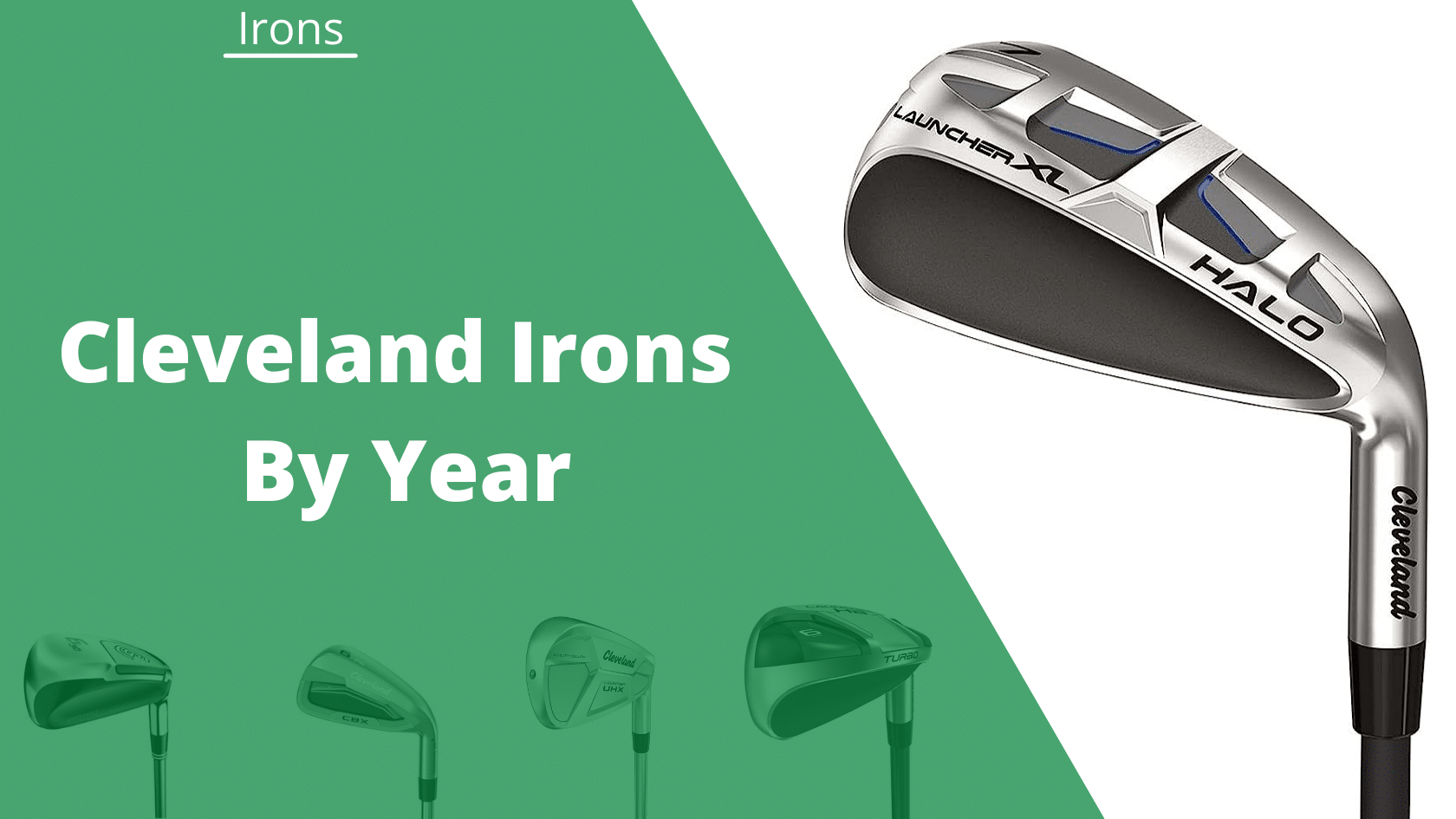
2022: Launcher XL Halo Irons
By 2022, Cleveland fully embraced its identity as the king of user-friendly clubs. The Launcher XL Halo irons featured:
- XL Head Design: Huge sweet spot and extreme MOI
- Gliderails on soles: Prevent chunked shots and help with clean contact
- Action Mass CB: Weight in the grip for better tempo
These irons were specifically crafted for golfers who struggle to get the ball airborne. With a wider sole and hybrid-like construction, the XL Halo irons were a dream for high handicappers, older players, and anyone fighting a slice.
Compared to the 2019 Turbo set, the XL Halo irons added more stability and control while keeping the same effortless launch and forgiveness.
Bonus: Cleveland also introduced Smart Sole wedges around this time, which paired beautifully with these irons for an ultra-forgiving full set.
2023: Cleveland XL Halo & HB Soft Tech Updates
In 2023, Cleveland made minor but meaningful tweaks. The Launcher XL Halo irons remained popular, and Cleveland introduced new HB Soft Tech upgrades focused on feel and weight distribution.
This year also saw Cleveland pushing more into smart weighting systems, especially with grip-weighted technology that helped players with swing tempo and consistency.
Additionally:
- More shaft flex and weight options became available
- The brand enhanced their fitting systems through certified retailers
- Marketing leaned heavily on ease-of-use, consistency, and joy of play
While not a major shift in design, these updates solidified Cleveland’s reputation as the most forgiving iron brand in golf.
2024: New Innovations in Cleveland Irons
2024 brought more refinement than reinvention, but the changes still made waves among Cleveland fans. The release of the Launcher XL2 irons was the headline of the year. Cleveland focused on refining what already worked—mainly forgiveness, launch, and ease of play—while dialing in more control and feel for players who wanted a touch of precision.
Key upgrades in 2024:
- XL2 Design Tweaks: Slightly slimmer profile for a more iron-like look, especially in the short irons
- Improved Weight Distribution: New internal weighting system for better turf interaction
- Refined Face Technology: Boosted ball speed on both center and off-center hits
The XL2 line also offered new shaft options tailored to senior players and women, further establishing Cleveland as a leader in accessible golf equipment. They maintained the signature Action Mass CB weighting in the grip, helping improve tempo and clubhead awareness.
What really stood out in 2024 was Cleveland’s attention to user feedback. Players wanted more stopping power in short irons, better transition from hybrid-like long irons, and more traditional looks in the scoring clubs. Cleveland delivered.
While competitors pushed flashy new tech, Cleveland stayed grounded—focusing on the fundamentals of making golf enjoyable for the everyday player.
Comparing Cleveland Irons Through the Years
To really appreciate how Cleveland irons have evolved, it helps to see them side by side. Here’s a comparative look at key models from different eras:
| Year | Model | Target Golfer | Tech Highlights | Notes |
| 1995 | VAS 792 | High-handicap | Vibration Absorbing System | Controversial design, very forgiving |
| 2001 | TA5, TA7 | Mid-handicap | Cavity back, improved feel | Traditional shape, balanced performance |
| 2006 | HiBore Irons | Seniors, high-handicap | Hollow head, high launch | Seamless hybrid transition |
| 2011 | CG16 | Mid to low-handicap | Laser-milled grooves, soft feel | Forged-like performance |
| 2012 | 588 Forged | Low-handicap | 1025 carbon steel, minimal offset | Tour-level feel and workability |
| 2014 | 588 TT/MT/Altitude | All skill levels | Progressive design, tailored forgiveness | Customizable sets |
| 2017 | Launcher HB | High-handicap | Full hybrid set, hollow construction | Game-changer for easy launch |
| 2019 | Launcher HB Turbo | High-handicap | Turbocharged face, speed tech | Even more forgiveness |
| 2021 | Launcher UHX | Mid-handicap | Mixed hollow and cavity back | Great balance of control and distance |
| 2022 | Launcher XL Halo | Beginners, seniors | XL head, smart sole, Action Mass CB | Top-tier forgiveness |
| 2024 | Launcher XL2 | All skill levels | Sleeker profile, enhanced face tech | More control, same forgiveness |
Who Are Cleveland Irons Best Suited For?
This is the million-dollar question, isn’t it? While many brands try to cater to tour players and elite amateurs, Cleveland has always marched to the beat of their own drum. Their irons are built for the rest of us—the average weekend warrior, the senior golfer getting back into the game, or the beginner who just wants to hit it straight.
Ideal Cleveland Iron Users:
- Beginners: Easy to launch, very forgiving, and confidence-inspiring at address.
- Seniors: Lightweight shafts, hybrid designs, and built-in tempo assistance through grip weighting.
- High Handicappers: If you struggle with consistent contact or slicing, Cleveland’s hybrid-style irons are magic.
- Occasional Golfers: Don’t play every week? These irons help you get back in rhythm faster.
Not Ideal For:
- Tour Pros: You won’t see many (if any) Cleveland irons on the PGA Tour.
- Low Handicappers: Players who want full control, shot shaping, or feedback might prefer brands like Mizuno or Titleist.
Bottom line? If you care more about hitting greens than looking cool doing it, Cleveland irons are your jam.
Tips for Choosing the Right Cleveland Irons
Shopping for new irons can be a mental minefield. With Cleveland offering multiple sets that look similar but perform differently, how do you pick the right one? Let’s simplify it.
1. Know Your Skill Level
- New to Golf? Go for Launcher XL Halo or HB Turbo. They’re designed for max forgiveness.
- Mid-handicapper? Try Launcher UHX or a combo of TT/MT from the 588 series.
- Low handicap? If you must go Cleveland, the 588 Forged is your best bet.
2. Understand Your Swing Speed
Slower swing? Look for lightweight graphite shafts and higher launch characteristics (HB or XL Halo). Faster swing? Go steel with something like the UHX or 588 TT.
3. Get a Fitting if Possible
Cleveland offers club fitting through several retailers. A quick session can help you:
- Choose the right shaft flex
- Dial in your lie angle
- Optimize distance gaps
4. Consider Combo Sets
One of the best things about Cleveland is how well their irons blend together. Don’t be afraid to create a hybrid-irons-long, cavity-back-short combo set.
Where to Buy Cleveland Irons (New and Used)
You’re sold—now where do you buy? Good question. Cleveland irons are widely available both new and used, which makes them budget-friendly too.
Best Places to Buy New:
- ClevelandGolf.com – Official store with full warranties
- PGA Superstore / Golf Galaxy – Try before you buy
- GlobalGolf / RockBottomGolf – Great deals and clearance models
Best Places to Buy Used:
- Callaway Pre-Owned – Occasionally carries Cleveland sets
- eBay – Good prices, but check seller ratings
- 2nd Swing Golf – One of the best for used clubs in great condition
Tips for Buying Used:
- Check grooves, shafts, and grips
- Ask for serial numbers to confirm authenticity
- Look for matching sets with consistent wear
Conclusion
From the funky VAS irons of the ‘90s to the sleek and forgiving Launcher XL2s of today, Cleveland has carved out its own lane in the golf world. They don’t chase Tour validation or flashy endorsements—they serve the everyday player with consistency, innovation, and forgiveness where it counts.
Whether you’re just getting started, coming back after years away, or looking to make golf a little easier on the body (and ego), Cleveland irons offer something rare—fun without frustration.
So, next time you’re standing on the tee box, staring down a 150-yard approach shot, remember this: you don’t need to play what the pros play—you just need clubs that help you play better. And that’s exactly what Cleveland irons do.
FAQs
1. What are the most forgiving Cleveland irons ever made?
The Launcher HB Turbo and Launcher XL Halo irons are widely considered Cleveland’s most forgiving sets. With hybrid designs, wide soles, and massive sweet spots, they’re ideal for beginners and high handicappers.
2. Are Cleveland irons good for beginners?
Absolutely. Cleveland has been praised for making some of the best beginner-friendly irons in golf. The XL Halo series and HB models are especially suited for those just learning the game.
3. Do any pros use Cleveland irons?
Not really. While some pros use Cleveland wedges (especially from the RTX line), their irons are mostly geared toward amateurs. Cleveland focuses on helping average players, not competing on tour.
4. What’s the difference between Launcher HB and UHX irons?
Launcher HB irons are full hybrid sets with maximum forgiveness. UHX irons, on the other hand, blend hollow long irons with cavity-back short irons, offering a better balance between control and ease-of-use.
5. Are older Cleveland irons still worth buying?
Yes—especially models like the 588 TT, CG16, or even HB Turbo. If they’re in good condition, these irons still hold up well and can be great value for the money.
Related equipment research
Compare the iron timeline with our golf club category guide and the companion Cleveland drivers timeline.

Leave a Reply