
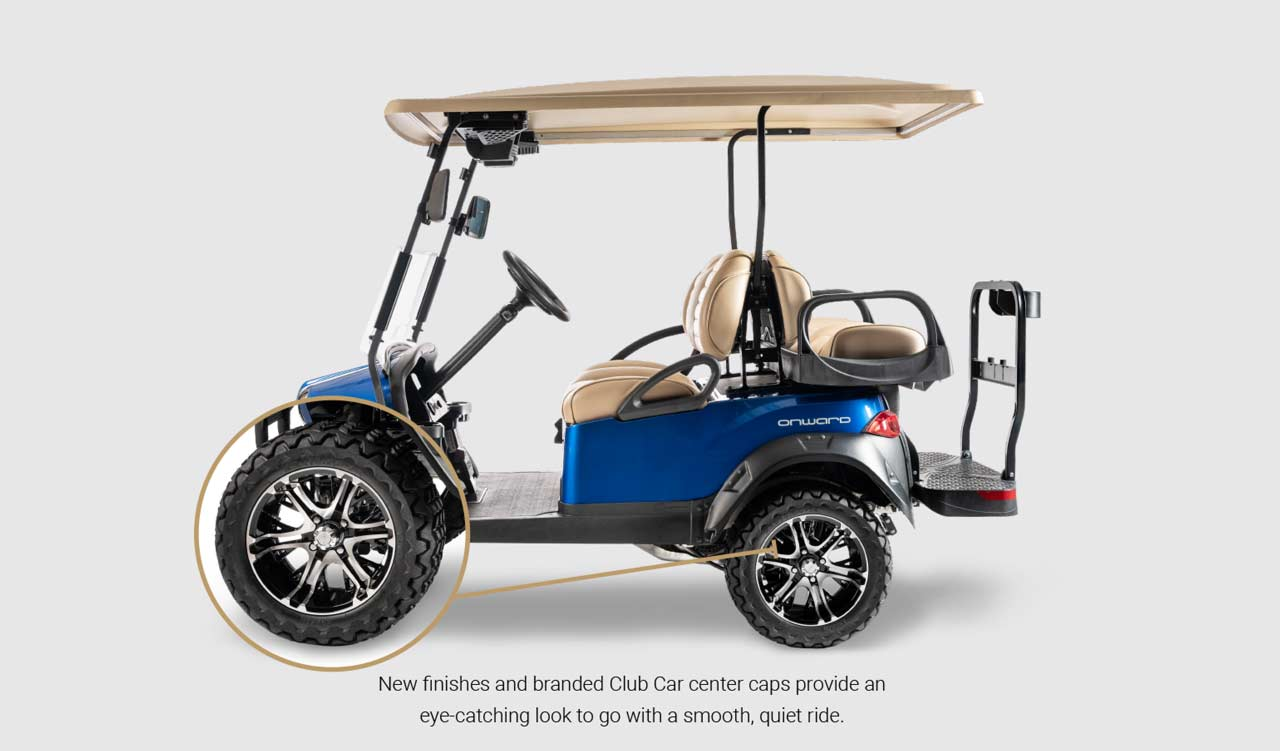

There are many great golf carts available on the market today, each with its own unique features and advantages. However, one of the best golf carts on the market right now is the Club Car Onward. The Onward is a high-quality golf cart that comes in a variety of configurations, from the standard two-seater to the larger four-seater models.
One of the standout features of Onward is its high-quality construction and attention to detail. The Onward is built with a rustproof aluminum frame, which makes it both durable and lightweight. It also features a best-in-class suspension system, which provides a smooth and comfortable ride on even the most uneven terrain.
The Onward also comes with a range of customizable features, including a variety of color options, seat materials, and accessories. This allows golfers to personalize their carts to their own preferences and needs.
In addition to its quality construction and customizable features, the Club Car Onward is also highly efficient and easy to maintain. It features a powerful electric motor that provides excellent performance while also being quiet and emissions-free. And with a range of up to 50 miles on a single charge, it’s perfect for all-day golf outings.
Overall, the Club Car Onward is a top-performing golf cart that offers exceptional quality, customization options, and efficiency. It’s no wonder that it’s one of the best golf carts on the market today.
Below are some best golf cart models we have tested and evaluated. For your reference
[content-egg-block template=offers_grid]
First decide which type of golf cart you mean
“Golf cart” can describe a full-size riding vehicle, a powered trolley that follows or carries a golf bag, or a manual push cart. These products solve different problems and should not be compared in one ranking. A riding cart is a vehicle purchase with storage, charging, transport, maintenance, and local-use considerations. A powered trolley reduces walking load while the golfer remains on foot. A push cart is simpler, lighter, and usually easier to own.
How to compare a riding golf cart
Start with the intended environment. A cart used only on private property has different requirements from one transported to multiple courses or operated where local rules permit low-speed vehicles. Verify permitted use with the relevant property, course, community, or local authority before purchase. Do not assume lights, mirrors, seat belts, or a slow top speed automatically make a cart street legal.
For electric carts, compare battery chemistry, usable range under realistic load, charger requirements, replacement cost, warranty, and local service support. Advertised range can vary with terrain, temperature, tire pressure, passenger weight, accessories, and battery age. For gasoline carts, consider fuel storage, noise, ventilation, scheduled service, and whether the intended facility allows them.
Practical inspection points
- Brakes and steering: operation should feel predictable without excessive play, pulling, grinding, or warning lights.
- Frame and roof: inspect for corrosion, cracks, poor repairs, and damage around mounting points.
- Tires and suspension: uneven wear can indicate alignment, pressure, or component problems.
- Charging system: confirm charger compatibility, cable condition, charge time, and outlet requirements.
- Payload and seating: use manufacturer limits; rear-seat conversions and cargo boxes change weight distribution.
- Parts and service: a low purchase price is less attractive if batteries, controllers, body panels, or qualified service are difficult to obtain.
Buying a used cart
Ask for the serial number, model year, maintenance record, battery installation date, charger, keys, manuals, and documentation for major upgrades. Inspect the cart cold rather than after the seller has charged or warmed it. Test acceleration, braking, reverse, steering, lights, and operation on a safe incline. Battery replacement can materially change the real purchase price, so a professional inspection is sensible when service history is incomplete.
Transport, storage, and ownership cost
Measure the storage area, trailer, ramp, and tow-vehicle capacity before purchase. Include tie-down points and roof height. Ownership cost may include batteries, charger, electricity or fuel, tires, brake service, insurance, registration where applicable, winter storage, and transport. Accessories add cost and can affect stability or warranty coverage.
Who should consider a trolley or push cart instead?
If the goal is simply to reduce bag weight while walking, a powered trolley or push cart is normally a more focused solution. Compare folded dimensions, total weight, handle adjustment, brake control, wheel stability, battery availability for powered models, and how easily the unit moves between trunk and course.
Bottom line
The best cart is the one supported locally, suited to its permitted environment, manageable to store and transport, and affordable over its full ownership life. Avoid rankings based mainly on speed or accessories. Start with use case, safety, serviceability, and realistic cost.
Related: see our golf accessories guides and golf bag guide for easier course access.
Questions to ask the dealer
Ask who performs warranty work, which components are covered, whether labor and transport are included, and how long common parts usually take to obtain. For an electric cart, ask how battery health is documented and whether the charger is original and matched to the installed battery system. For a modified cart, request the part list and the name of the installer. Suspension lifts, larger tires, rear seats, speed changes, audio systems, and lighting can affect range, stability, serviceability, and warranty coverage.
Before accepting delivery, obtain the serial number, owner’s manual, charger documentation, keys, service contacts, and a written list of included accessories. Confirm delivery dimensions and whether the driver will demonstrate charging, braking, controls, and safe shutdown. A dealer’s ability to explain maintenance and supply parts is often more valuable than a long accessory list.
Final pre-purchase checklist
- The cart type matches the actual use case.
- Storage, transport, charging, and local-use requirements have been verified.
- Payload, seating, and manufacturer safety limits are understood.
- Battery age or engine service history is documented.
- Total ownership cost fits the budget after accessories and maintenance.
- A local service and parts path exists.
- The purchase agreement states warranty, return, and delivery conditions.
Do not skip a demonstration
A short demonstration should include entry and exit, seat and control reach, forward and reverse operation, controlled braking, turning space, parking brake use, charging connection, and loading considerations. The intended primary driver should perform these checks personally. Comfort and control accessibility cannot be confirmed from a specification sheet, and a cart that is awkward in a showroom is unlikely to become easier during regular use.

Leave a Reply