
Editorial note: This guide explains fitting principles, not a universal prescription. Labels and specifications vary by manufacturer. Compare complete club builds and use measured ball flight whenever possible.
The most forgiving iron is the model that preserves useful carry and direction on your common miss while still moving through your normal turf. A large head or strong marketing claim does not identify that result by itself.
Forgiveness must match your miss
Golfers do not all miss the center in the same way. One player strikes low on the face, another toward the toe, and another varies turf contact. A model that protects toe speed may help the second golfer more than the first. Begin by identifying where your impact pattern actually lives.
Forgiveness also includes direction. A shot that retains ball speed but curves far offline has not produced a useful outcome. Compare the total area of the landing pattern and the carry of the shortest normal miss.
The five parts of iron forgiveness
1. Ball-speed retention
Measure how much carry falls on ordinary off-center strikes. The useful iron keeps gaps recognizable instead of producing occasional jumpers surrounded by short shots.
2. Launch and playable height
A low-spin, strong-lofted iron may create impressive peak distance but fail to hold a green. Check peak height and descent with the ball you normally play. Slower-speed golfers often need enough loft and a suitable shaft to turn speed into carry.
3. Directional stability
Perimeter weighting and head geometry can reduce twisting, but delivery still controls the face. Judge the complete dispersion ellipse. A compact-looking pattern is more meaningful than a single straight shot.
4. Sole interaction
Sole width, bounce, leading-edge shape and turf conditions influence contact. A wider sole can resist digging, while a narrower sole may enter firm turf more cleanly for another player. Test from grass when possible.
5. Set progression
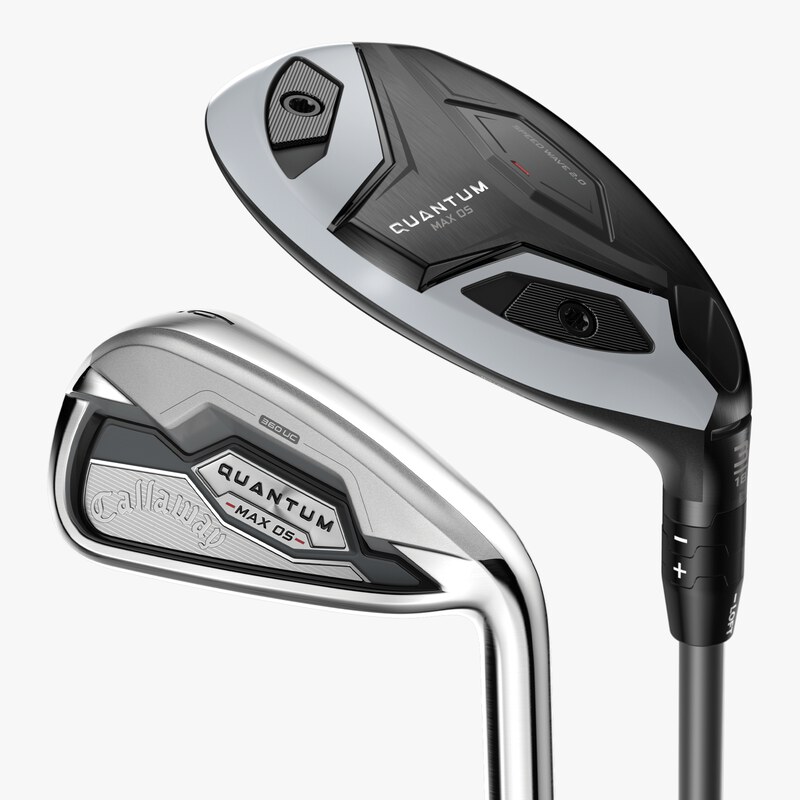
The 7-iron may be easy while the 5-iron is not. Evaluate the longest iron separately and compare it with a hybrid. Combo sets can deliver iron-like control in shorter clubs and easier launch at the top.
How to read a distance comparison
Do not compare two 7-irons without checking loft and length. Modern models with the same number can differ enough to behave like different clubs. Record carry, not total rollout, and examine gaps to the clubs on either side. A “longer” 7-iron that creates a gap elsewhere may require additional wedges or a different set composition.
Confidence matters, but verify it
Top-line thickness, offset and head size affect how comfortable a club looks. Confidence can support a committed swing, so appearance is not trivial. It should still be confirmed by strike and ball-flight data rather than treated as proof of forgiveness.
A repeatable way to test the choice
Begin with your current club as the baseline. Warm up normally, choose one ball model and hit to the same target. Alternate between the baseline and candidate in short blocks so fatigue or adaptation does not favor one option. Keep normal misses in the sample; deleting every poor strike creates a result that will not survive on the course.
Record carry distance, peak height, start direction, curvature, strike location and the total width of the shot pattern. Distance is useful only when the ball launches into a playable window and lands with enough control. Ten representative shots normally tell you more than one exceptional swing. If the result is close, repeat the comparison on another day or outdoors before ordering a custom specification.
Change one major variable at a time. A different head, shaft weight, flex, length and grip can all alter delivery. When everything changes together, you may know that one club performed better without learning why. Ask the fitter to write down the exact head, loft, lie, length, shaft model, shaft weight, flex, tipping and grip so the club you receive matches the club you tested.
Common mistakes to avoid
- Choosing from age, handicap or a shaft label alone.
- Comparing clubs with different lengths or lofts and crediting every change to one component.
- Using only the best shot instead of the complete dispersion pattern.
- Chasing low spin or maximum distance without checking carry and landing angle.
- Ordering a custom build before confirming return, alteration and warranty terms.
Decision checklist
- Write down the problem the change is supposed to solve.
- Establish baseline carry, height and dispersion.
- Confirm the exact specification rather than only the model name.
- Test with the same ball and a realistic target.
- Compare ordinary strikes and misses.
- Check gapping with the clubs immediately above and below it.
- Save the fitting sheet for future adjustments.
Frequently asked questions
Do wider soles make irons more forgiving?
They can help some golfers avoid excessive digging, but a sole that is too wide or has the wrong bounce for the delivery and turf may create contact problems.
Are stronger-lofted irons more forgiving?
Strong loft can add distance, but forgiveness also requires playable launch, carry consistency and stopping ability. Compare equivalent carry gaps rather than only the number stamped on the club.
Should high handicappers avoid long irons?
Not automatically. Keep the longest iron you can launch and strike reliably. Replace clubs above that point with hybrids or fairway woods if they produce better carry and descent.
Can a players iron be forgiving?
Some compact irons preserve speed well, but head size and sole design generally provide less help for certain misses. The answer depends on the player’s strike pattern.
Related buying guides
Compare the current best irons for high handicappers, our complete club buying guide and the club-fitting checklist.
Sources and review policy
Current comparison points were checked against official manufacturer specifications, including Callaway Quantum Max OS and PING G440. Product specifications and fitting guidance were checked on August 17, 2026. We update this page when fitting guidance or linked product families change.

Leave a Reply